


Over the past two weeks in Gaza, social media discourse and the correlating sentiments have revealed a continued growing anger and resentment toward Hamas and toward systems within Gaza that are controlling access to goods and resources, leading to a deeper fragmentation in society. As that unfolds, Gazans are increasingly turning toward new digital and informal channels to sustain their daily lives.
All the while, despite the war in Iran having been portrayed as a “theater of resistance,” some Gazans are remarking that it is an ineffective theater for that purpose, and that Gaza is being used for a theatrical performance that, in the end, leaves them in even worse humanitarian conditions.
From external occupier to internal exploiter
Many Gazans are beginning to perceive that the pressures shaping daily life are emanating from internal sources rather than solely external ones. Civilian discussions have referenced a “domestic economic siege,” in which internal actors (Hamas and others) are controlling access to essential goods, inflating prices, and extracting value from a population already under extreme strain. This discourse conveys that residents in Gaza are feeling the impact of internal economic issues as acutely as impacts from external military pressures.
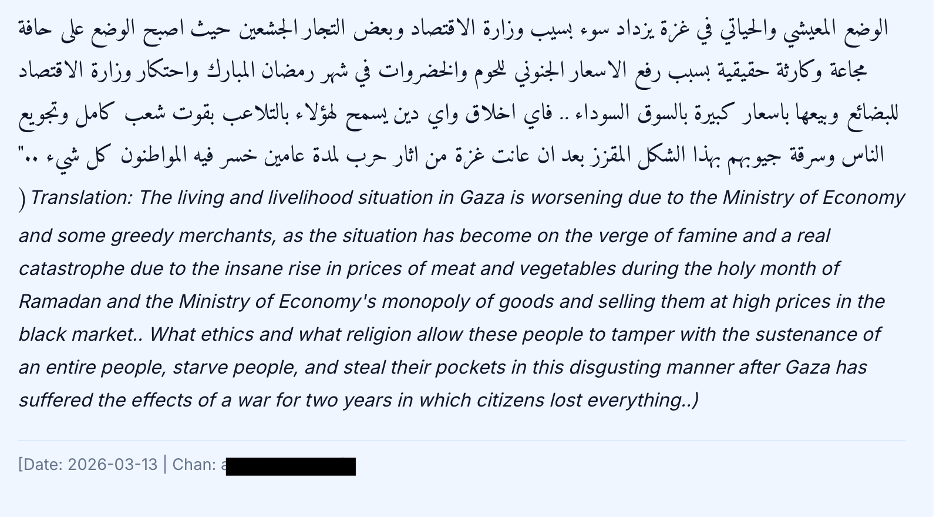
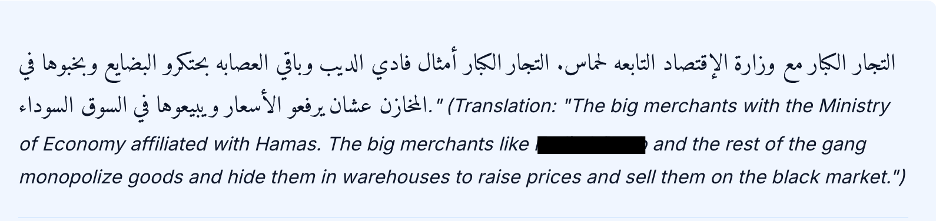
At the core of this shift is the formalization of what is sometimes called the tansiq (in Arabic, “coordination”) system, often described in ways that liken it to a cartel. Decisions by the Hamas-run Chamber of Commerce restrict the import of goods to a limited number of designated traders, effectively tightly controlling the flow of goods. The issues people discuss online are less about overall scarcity than about restricted access within a closely managed, controlled system. There may be goods in Gaza, but access to them is filtered through a narrow set of actors operating in coordination with the Hamas-led administration.
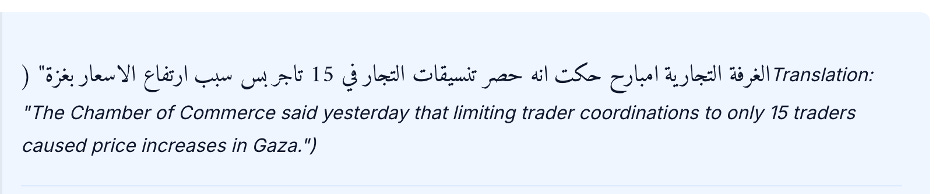
Public discourse increasingly points to monopolistic behavior in which major merchants hoard goods, release them selectively, and sell them at inflated prices through both formal and informal channels. External reports underscore the scale of the crisis, with food prices reportedly increasing as much as 84 percent week over week and surpassing 300 percent inflation compared to prewar prices, pushing Gaza closer to famine-like conditions. An important shift has taken place among locals: Previously, they saw these concerning trends as unavoidable outcomes of war; but now, they understand the trends as results from an intentional system.
With the inflated prices and the taxes charged, this system is effectively transferring wealth from the most vulnerable families—living in tents, displaced, and dependent—to those aligned with Hamas and Hamas-adjacent networks. The resulting zero-sum economy is fragmenting society, arguably dividing it into two classes: A tansiq class and a survival class. Such is development is destabilizing because it has reframed the crisis as one of internal, purposeful inequity rather than shared hardship. In some cases, the anger against these internal systems is as strong as the anger towards actual border closures by Egypt and Israel.
This perception has been reinforced by accusations that the Hamas-run Ministry of Economy is prioritizing institutional survival over public welfare, and that aid is being filtered, delayed, or diverted within the coordinated networks. This is a significant signal of mistrust in Hamas’s governance.
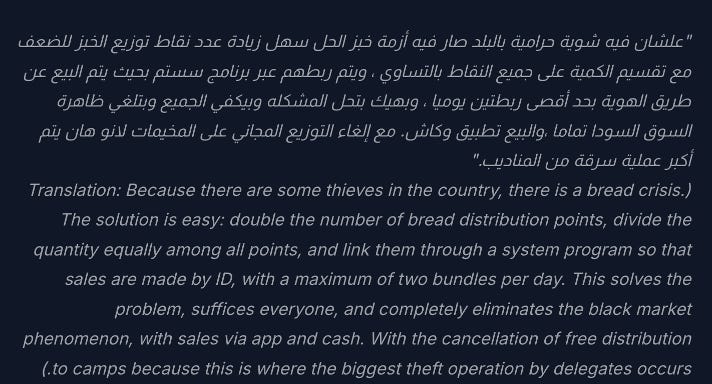
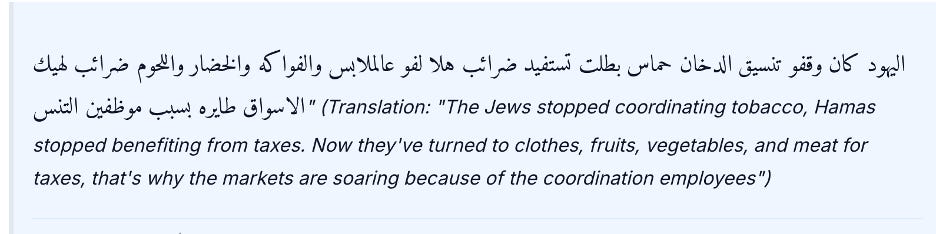
Informal and general discussion of the tansiq system is growing online. But among that discourse, there are allegations and claims that specific companies and entities, including Egypt-based ones operating in Gaza, are part of the tansiq systems. Reports indicate that fees imposed on traders have risen sharply, from a historical range of twenty thousand to fifty thousand dollars per truck to as much as $100,000 for general goods and up to $300,000 for medical supplies. These costs are passed on to consumers, meaning Gaza’s civilians. The result is a layered system of extraction in which each stage of movement and coordination adds to the final price of goods paid by Gazans in the market.
As trust in centralized systems erodes, Gazans are increasingly resorting to alternative mechanisms for survival, including by turning to digital finance, informal markets, and decentralized money networks. These mechanisms have expanded recently, enabling new pathways for access but also empowering a new class of unregulated actors that offer better access. With that being the case, establishing a new political authority from traditional pipelines is becoming less relevant, as it is not about who governs in name, but rather about who can deliver food, electricity, money, and security.
The ‘theater of resistance’
Overlying this shift is continued skepticism about the regional war. A prevailing narrative in Gaza increasingly frames the broader confrontation between the United States, Israel, and Iran as a performative display or a conflict that serves external interests while leaving Gaza’s humanitarian reality unchanged.
The war has not translated into meaningful improvements in access, mobility, or supplies. This perception reinforces a critical shift: Gazans are evaluating more on outcomes, not ideology. At the same time, the link between Gaza and the regional conflict does remain very real. The two are part of a single strategic system in which instability in one context inevitably reinforces instability in the other. De-escalation, therefore, must address both arenas simultaneously.
What this means for Gaza
The shift unfolding in Gazan discourse—in which more attention is placed on internal mechanisms of economic control—is bringing into question which groups hold legitimacy in the Strip and how they both earn and keep it. The emergence of monopolistic systems on one hand and decentralized networks of goods on the other (each fulfilling the wants and needs of different classes in Gaza) is fragmenting the foundations for future governance.
Thus, stabilizing Gaza will require more than additional aid from external sources or political negotiations. It will require building trust internally in how resources move, who controls them, how they are distributed, and whether the system is viewed as fair. Without that, Gaza is likely to move further down the pathway toward collapse.
Solution to the Israeli-Palestinian conflict:
https://worldpeacethroughworldwidedisarmament.blogspot.com/2015/11/the-israeli-palestinian-conflict.html
Amazing work!