In light of the crisis in Gaza, Realign For Palestine has partnered with Nisaba Technologies (which monitors real-time civilian discourse in Gaza via social media posts) to explore how Gaza is experienced by civilians and highlight warning signs often absent from conventional reporting.
Since the United States and Israel launched strikes on Iran, the expanding regional war has reverberated inside the Gaza Strip. The war hasn’t brought direct military confrontation into Gaza, but it has impacted political rhetoric, humanitarian pressure, and public sentiment.
Polarizing sentiment on Hamas
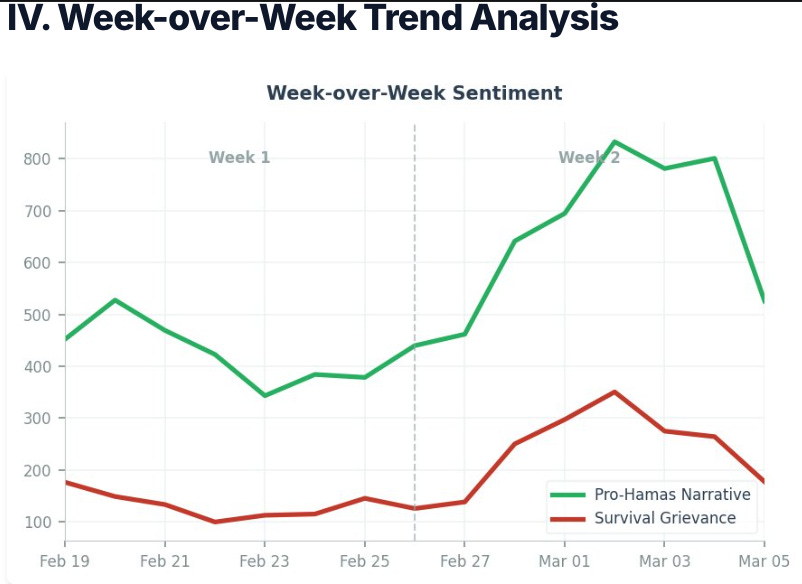
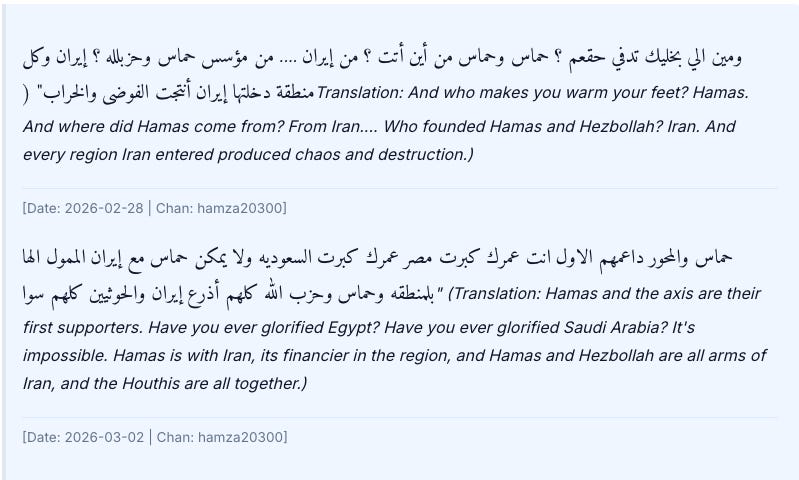
The war has had an interesting impact on the rhetoric around Hamas. Given how Hamas has framed the war as part of a broader confrontation with Israel and the United States, the war appears to have strengthened support for Hamas in some segments of the population. Yet, civilian discussions also show a significant surge in dissent, rising 71 percent week over week in the reporting data. The polarization reflects a population increasingly divided between those still rallying behind “resistance narratives” and those openly blaming Hamas for Gaza’s devastation and its inability to govern daily life.
A similar divide is appearing in the public’s sentiment about the ongoing alignment between Hamas and the Iranian regime, a topic that did not feature prominently in previous weeks. Some Gazans criticize Hamas and its alliance with Iran for having helped produce Gaza’s collapse, while others continue supporting Hamas narratives of “steadfastness” and “armed resistance.”
The splintering of public opinion takes place amid a wider backdrop of a breakdown in governance, in which local clans and informal networks are increasingly attempting to usurp control over territory and resources that are typically managed by a centralized authority.
Yet, hunger and danger remain major concerns
While the war has influenced narratives both supporting and criticizing Hamas, the central questions for Gazans are far more practical: who can actually move food, control prices, secure neighborhoods, and deliver minimally credible governance. At present, no actor, including Hamas, has full control to perform these functions.
With the war unfolding, Gaza’s already fragile environment has become even more volatile. Border crossings have tightened, aid flows have fluctuated, and economic activity has become even more constrained as the war affects the movement of goods and humanitarian supplies. Moreover, Gazans fear that their circumstances have become a secondary geopolitical concern amid the wider conflict with Iran, despite the more than two million Palestinians still trapped in an extreme and constantly evolving humanitarian crisis.
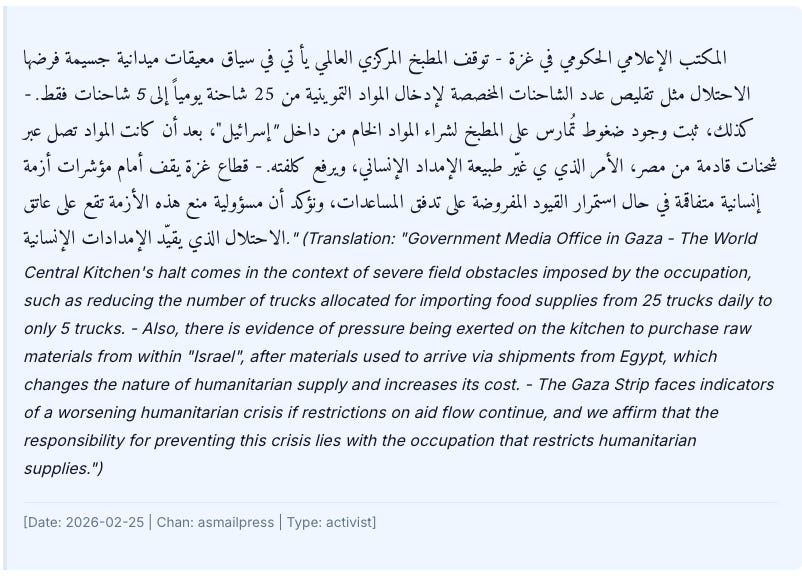
Civilians have described their daily conditions as worsening, with food access, aid distribution, and local market prices becoming increasingly unstable. Numerous reports since the US and Israeli strikes on Iran suggest that merchants are hoarding certain goods and sharply raising prices on essential food and household items. Discussions surrounding the suspension of the World Central Kitchen’s operations featured prominently during the reporting period, reinforcing fears that humanitarian assistance is becoming more erratic, less reliable, and increasingly insufficient.
A warning sign for civil unrest
The coming weeks will depend heavily on how long the war persists and how deeply it continues to destabilize conditions inside Gaza. Policymakers—including those involved in the Board of Peace and the technocratic committee—should closely monitor how the wider conflict is affecting aid access, border operations, and internal stability in the Strip.
Finally, observers should watch for warning signs of broader civil unrest. As hunger deepens and economic collapse accelerates, it remains possible that public anger could once again spill into open protest, as has occurred at various moments. It remains to be seen whether the recent rise in negative sentiments toward Hamas will translate into sustained collective action, and whether Hamas will continue to be a source of frustration within a fragmented society. Sentiments around Hamas and the potential impacts of these sentiments will be an important indicator to monitor in the coming weeks.