


In light of the crisis in Gaza, Realign For Palestine has partnered with Nisaba Technologies (which monitors real-time civilian discourse in Gaza via social media posts) to explore how Gaza is experienced by civilians and highlight warning signs often absent from conventional reporting.
At this weekend’s Munich Security Conference, Nickolay Mladenov, who serves as high representative for Gaza on the US-led Board of Peace, cast an important spotlight on the fragility of the cease-fire in Gaza, warning that significant violations are jeopardizing the agreement’s sustainability, as well as progress on post-war governance and reconstruction. That assessment aligns with what civilians in Gaza fear. Throughout messages we observed this week, uncertainty about the cease-fire’s durability and the viability of the second phase overall was rampant.
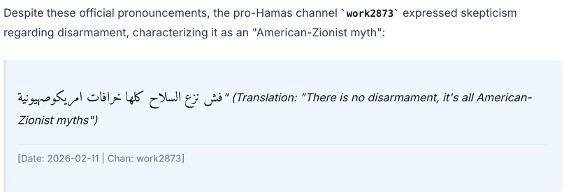
One part of the cease-fire agreement drew particular attention this week: disarmament.
Across messages observed in Gaza’s online discourse, civilians frame disarmament as a highly sensitive issue. But the concerns over disarmament appear to be rooted in fear rather than in ideology. Commentary online casts weapons as instruments of deterrence under asymmetric conditions.
In addition, many of the messages about disarmament portray it as a precondition imposed from outside, or a concession made without enforceable guarantees, and they warn about the effects disarmament could have on Palestinian vulnerability and future sovereignty. Across the board, skepticism remains high regarding whether external actors would honor commitments in exchange for a concession such as disarmament.
The strikes keep coming
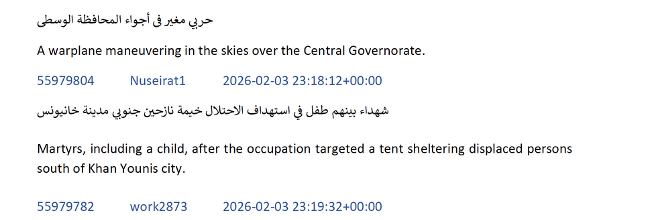
Gazan civilian discourse logged at least twenty-two military strikes across the Strip during the reporting period.
From what Gazans have posted online, it is clear that danger and constrained mobility continue to restrict daily life. Uncertainty about the cease-fire’s durability and the shifting boundaries of risk shape civilians’ decisions about their movements. Residents rely heavily on informal warning networks and word-of-mouth communications to determine safe routes. The Yellow Line functions as a fluid zone, often enforced through surveillance mechanisms remotely. Even within displacement zones, families delay relocation decisions until it becomes clearer whether the cease-fire’s second phase will proceed.
Northern Gaza, particularly Al-Tuffah, Al-Zaytoun, Al-Nasr, and Jabalia, continues to experience shelling, drone activity, and sniper fire, affecting residential areas rather than a defined battle zone. Civilians talk of fatalities in homes, on streets, and at social gatherings and interpret these instances as violations of civilian sanctity and protection norms. Central Gazans report drone and aircraft strikes, while southern Gazans report strikes near displacement areas. Across regions, the second phase of the twenty-point Gaza peace plan introduced by US President Donald Trump remains uncertain and is viewed with apprehension.
Prices are soaring
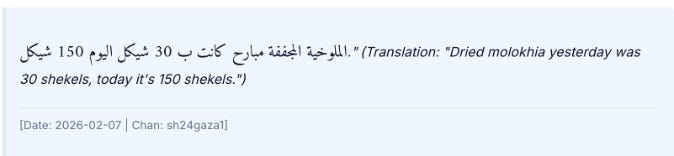
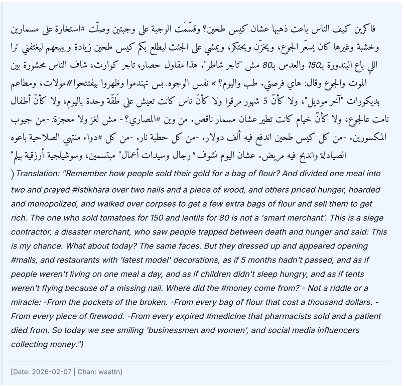
Prices for flour, gas, and other basic goods remain elevated with regional variation across the Strip. Reports indicate that a kilogram of flour costs 130 Israeli new shekels (about forty-two dollars) this week. Cigarettes, considered a luxury item, reportedly cost up to five hundred dollars per pack. Scarcity persists, and predictability remains limited. Fuel shortages, driven by both availability constraints and high costs, limit and disrupt bakeries, medical facilities, and other critical services. Residents in central and southern areas of the Strip note that local markets offer limited fresh produce, dairy, and meat, while civilians posting from northern Gaza say that markets there largely lack these goods entirely.
Civilians report that aid continues to fail to reach northern areas in any meaningful quantity. In central and southern Gaza, aid remains visible, but consistently insufficient relative to the need. Long queues, repeated registration attempts without delivery, and confusion regarding responsibility for distribution contribute to frustration and perceptions of inequitable access. Residents blame corruption, but those are primarily moral accusations based on feelings of betrayal and inequality, rather than explicit allegations or documented claims.
Skepticism and disappointment
Civilians have been persistently skeptical about international actors. Their messages have included references to the United States, the United Nations, and the Palestinian Authority. Civilians frequently say the United States is capable of applying pressure but unwilling or unable to translate that pressure into tangible improvements in humanitarian conditions.
Regarding other international actors, civilians frame Qatar primarily as a facilitator rather than a controlling actor. Iran appears in the discourse primarily within a regional context, but the online discourse largely does not portray Iran as an actor directly shaping daily conditions in Gaza. In contrast, Israel is consistently portrayed as an immediate and direct actor shaping conditions and realities on the ground.
People in Gaza widely perceive externally generated political proposals, including governance councils and reconstruction frameworks, as top-down initiatives tied to broader geopolitical maneuvering rather than participatory processes. Many civilians express unease about decision making that is done without local participation. Even voices critical of existing leadership hesitate to endorse externally imposed structures. In reconstruction discussions, there is also concern that aid and rebuilding will become instruments of political restructuring and control, rather than neutral humanitarian outreach.
Hamas still in the conversation
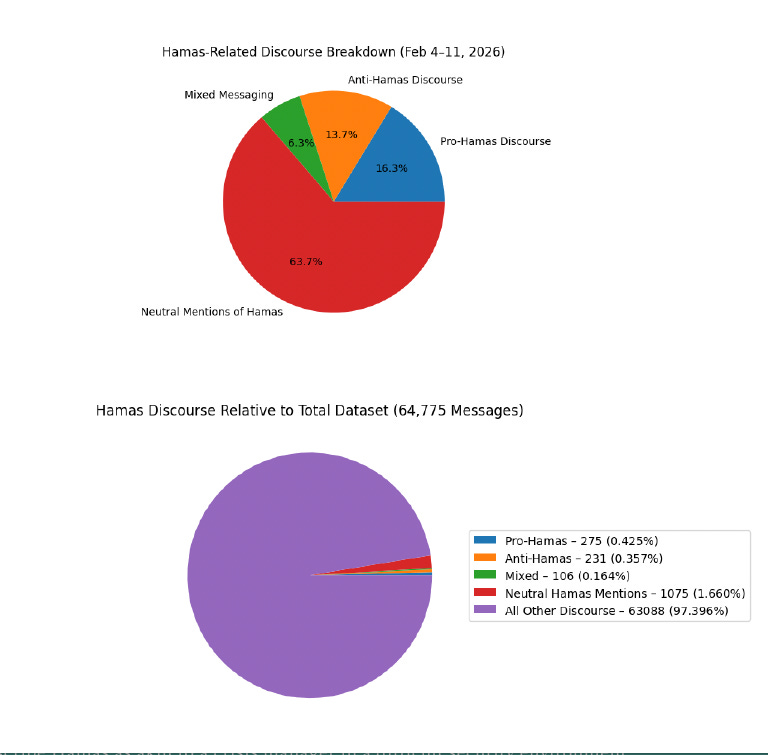
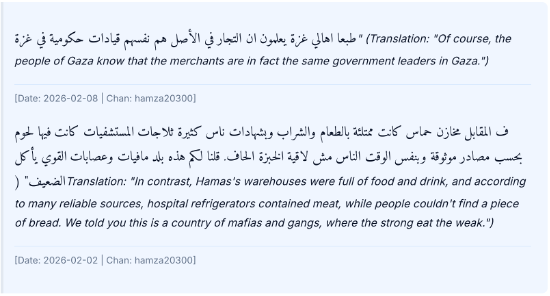
Hamas remains present in civilian discourse but does not appear to be widely embraced. Pro-Hamas messages account for a small share of the overall discussion and are mostly pragmatic rather than symbolic or ideological. Civilians frequently describe Hamas as akin to a crisis manager in a difficult security environment, necessary for negotiation, continuity, and internal order. But participants in Gaza’s online discourse largely did not idealize the group.
Support for Hamas appears conditional and outcome-driven. If cease-fire conditions hold and aid flows improve, civilians appear to be more tolerant online. But during escalation or an intensification of shortages, skepticism and distancing become more common.
At the same time, explicit anti-Hamas messages remain limited. The relative absence of Hamas from discussions of daily survival may suggest that the population does not consider governance to have an effective role in shaping daily outcomes. Ongoing references to new internal security mechanisms call out Hamas’s consolidation of control. Civilians appear to judge Hamas by what it can provide rather than by ideology or a sense of collective aspiration.
A dark shadow as leaders meet
Across all types of discourse, discussion about survival continues to supersede political conversation. In Gaza, civilians assess stability by their access to bread, fuel, and physical safety, rather than by diplomatic language that remains largely intangible in daily life.
Beyond that, the conversation about disarmament is significant, as are interpretations that externally driven political processes reflect existing power imbalances rather than genuine global partnership. The latter casts a dark shadow as the Board of Peace holds its first meeting in Washington, DC, where participants are slated to contribute funds and chart the way forward for phase two in Gaza.