


In light of the crisis in Gaza, Realign For Palestine has partnered with Nisaba Technologies (which monitors real-time civilian discourse in Gaza via social media posts) to explore how Gaza is experienced by civilians and highlight warning signs often absent from conventional reporting.
Regional military escalation continues to dominate global headlines, yet conversations inside Gaza are increasingly centered on a different question: who is responsible for the collapse of daily life in the Strip?
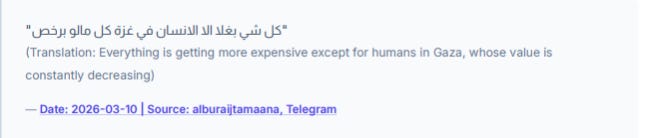
The security situation continues to deteriorate under the combined pressures of ongoing Israeli military operations, humanitarian strain, and a weakening social order. In public discourse over the reporting period of March 9 to 13, ideological narratives of resistance appear to have given way to conversations grounded in the realities of survival—market instability, economic pressure, and diminishing trust in governing authorities.
For most Gazans, daily life remains precarious. Widespread displacement persists, and recent incidents—including the collapse of a structural wall onto civilian tents, resulting in mass casualties—have reinforced the fragility of already unsafe living conditions.
At the same time, global attention remains fixed on regional escalation. Missile strikes across the region are often framed in Western-based “pro-Palestine” movements and external groups as acts of solidarity with the Palestinian cause. Inside Gaza, however, civilians increasingly view these developments as disconnected from the cause, and in some cases, they even argue that the regional war is exacerbating the difficulties Palestinians face. In that sense, a gap has appeared between geopolitical narratives being delivered on the global stage and the lived experience inside Gaza.
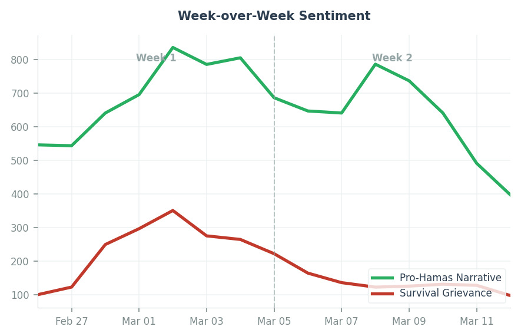
Economic grievances are outweighing political ones
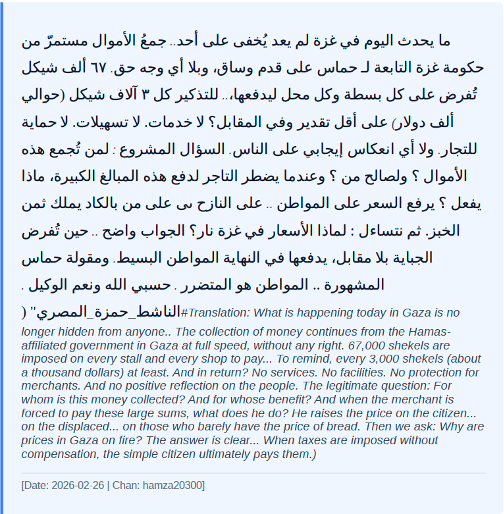
Economic pressures are squarely at the center of Gaza’s internal discourse.
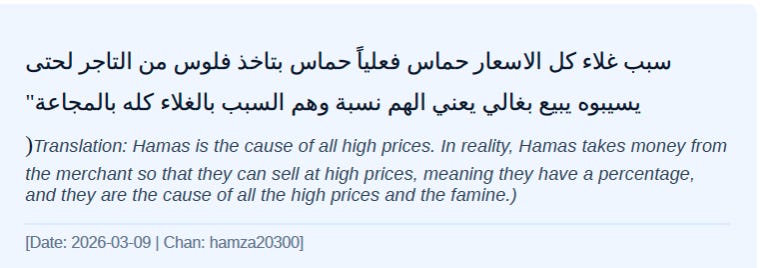
Residents increasingly use the term “khawa” (extortion) when talking about the informal levies imposed on goods and activities that are essential to daily life. These levies include fees on private electricity generators, charges on market stalls, and so-called “protection payments” tied to inflated prices. These costs vary by neighborhood and, while they are informal, they have become deeply entrenched in the economy.
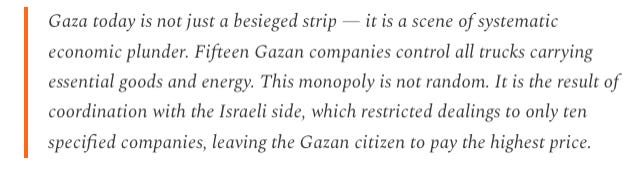
This aligns with broader discussions about monopolistic market behavior. The coordination systems behind the entry and distribution of goods have concentrated access to essential goods to a limited number of actors.
As a result, consumers have had to pay inflated costs for goods and services. Electricity from private generators, now a necessity due to the collapse of the grid, can cost as much as twenty-seven Israeli new shekels (about nine dollars) per kilowatt-hour. Combined with food shortages, supply bottlenecks, and price inflation, these pressures have made economic survival the dominant concern for many Gazans.
Public conversations increasingly reflect a belief that the crisis is not solely the result of external restrictions but also internal economic practices. Skepticism is growing around how goods are priced, how aid is distributed, and where resources ultimately go. The unpredictability of supply and the opacity of distribution systems have intensified anxiety around food security and basic survival.
The information ecosystem is shifting
A notable development is the rise of messages from those who identify as grassroots activists and citizen reporters. These kinds of messages garnered increasing influence within Gaza’s information ecosystem, based on the number of likes, reposts, and other engagements with this kind of content.
Operating largely through Telegram channels and informal digital networks, these individuals document economic exploitation, expose corruption, and circulate information that bypasses both official messaging and external narratives. These online discussions are beginning to function as parallel accountability systems. They track prices, name specific actors, document inconsistencies in aid distribution, and circulate real-time observations that are often more granular than formal reporting. This creates a bottom-up form of transparency that reshapes how legitimacy is assessed. Authority is no longer derived primarily from ideological positioning or political claims, but from whether actions can withstand continuous, decentralized scrutiny. In doing so, they are reshaping the internal conversation about governance, accountability, and Gaza’s future.
This decentralized flow of information is beginning to challenge both Hamas’s domestic messaging and the broader geopolitical framing of Gaza’s role in the regional conflict. It is also creating space for new forms of internal critique.
The growing visibility of local grievances, amplified by decentralized information networks, has created a space where criticism is increasingly expressed in collective and public terms. In this environment, the language used to describe suffering and assign blame is evolving, drawing on deeper cultural and moral frameworks to articulate a sense of injustice.
One of the most significant shifts is the changing use of religious language. Gazans are increasingly using traditional Islamic supplications—historically directed toward external adversaries—to express political frustration and, in some cases, to invoke divine judgment against Hamas leadership. This marks a meaningful transformation in the relationship between religious expression and political authority.
Over time, these kinds of grassroots networks may play a critical role in shaping internal political change by amplifying local grievances and redefining the terms of public discourse.
The risks associated with digital solutions are beginning to show
As Gaza’s physical infrastructure continues to degrade, many residents have turned to digital channels to manage daily survival.
Gazans are increasingly turning away from traditional networks of accessing aid and moving money, pivoting toward nontraditional networks—including Telegram groups, peer-to-peer wallets, and, increasingly, crypto-based transactions such as USDT (also known as Tether). They are doing so out of concern about the slowness and high costs affiliated with traditional formal channels. They’re also doing so as humanitarian agencies, including the World Food Programme, increasingly rely on digital wallets to distribute cash assistance in Gaza, with recent transfers reaching roughly 1,250 Israeli new shekels (about four hundred dollars) per household.
Digital wallets have become both a critical lifeline but also a source of uncertainty. The digital ecosystem is fragile. Much of Gaza operates on limited connectivity, often constrained to 2G networks, which significantly limits functionality. Moreover, these systems operate within a highly constrained infrastructure environment, marked by unreliable electricity, limited connectivity, and service disruptions. At the same time, reports of scams and fraud are on the rise. Fake wallet addresses, fraudulent charity appeals, and identity-based scams have left some families worse off after losing already scarce resources.
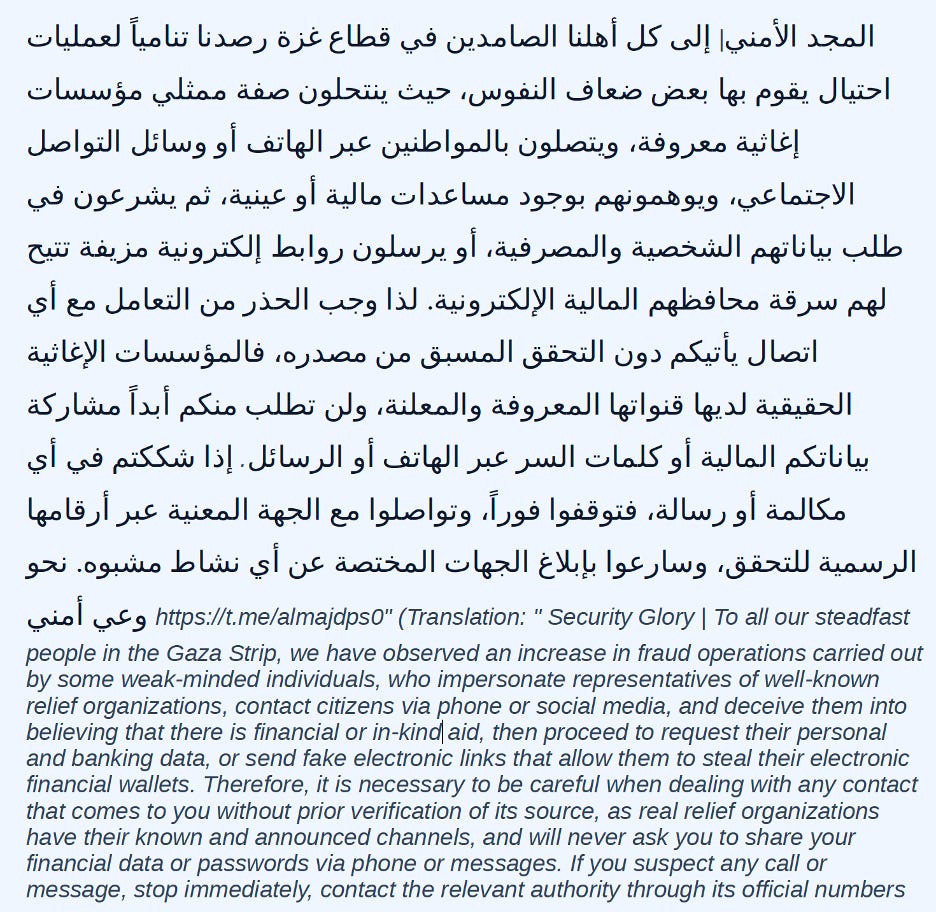
Local reporting and user-level accounts suggest that periods of high demand during aid disbursements can overwhelm these systems, temporarily limiting access to funds at the moment they are most needed. While these incidents are not formally documented in official reporting, they reflect broader concerns about the fragility of Gaza’s emerging digital financial infrastructure.
As a result, the digital financial system in Gaza reflects the same instability as the physical channels it was meant to supplement.
What happens next in Gaza will come from inside—not outside—the Strip
Taken together, these trends point to a fundamental shift in Gaza’s internal dynamics.
Economic hardship, market instability, and perceived internal exploitation are increasingly central to public discourse, rivaling—and in some cases surpassing—traditional political grievances. At the same time, the rise of decentralized information networks and the transformation of religious rhetoric suggest a deeper erosion of authority that extends beyond material conditions into the moral foundations of governance.
If current trends persist, the most consequential changes in Gaza will likely emerge not from regional military developments but from within. The convergence of economic pressure, fragmented information flows, and declining trust in centralized authority creates the conditions for an unstable political landscape.
In this environment, legitimacy will come not from ideology or external alignment, but from the successful provision of the basic conditions for life.
