


In light of the crisis in Gaza, Realign For Palestine has partnered with Nisaba Technologies (which monitors real-time civilian discourse in Gaza via social media posts) to explore how Gaza is experienced by civilians and highlight warning signs often absent from conventional reporting.
This week in Washington, the newly formed Board of Peace met to confirm pledges of donations and troops toward stabilizing Gaza. Meanwhile, the reality on the ground remains volatile and characterized by sustained military activities, internal friction, economic failures, and black markets. Civilian discussions we have analyzed this week center on deep insecurity, market instability, and the lack of clarity regarding governance and representation.
Enforcement from a distance
There were over a dozen reported incidents of strikes, artillery shelling, or drone fire found in online discourse among Gazans this week. Eastern Gaza City was one of several reported focal points of civilian fatalities, with artillery shelling and drone strikes impacting dense residential areas.
Civilian reports provided a multitude of examples in which the eastern perimeters, especially near Nuseirat and Khan Younis, were seen as being enforced through drones and precision fire from a distance, without an active troop presence. Additionally, reports of sniper fire near entrances to some villages or agricultural areas and peripheries in the eastern zones of Gaza add to these interpretations.
In many of these cases, casualty figures increased over days, suggesting delayed rescue efforts. Following these incidents, local hospitals, including Al-Shifa, reported overcrowding and limited capacity. For example, after a report of an airstrike on the Al-Dawli building, casualty reports climbed over several hours, reinforcing concerns reported on social media about restricted access to injured civilians and delays in recovering bodies.
In Al-Zaytoun, there were repeated reports of sniper fire that led to civilian deaths and injuries, including women and children. Similar patterns were observed in central and southern Gaza. Public sentiment was particularly focused on strikes in displacement zones, including tents housing displaced residents. Gazans discussed recurrent strikes in densely populated zones with increasing anger, frustration, and fear.

A notable incident this week was a reported airstrike targeting the Sheikh Radwan Police Station, resulting in sixteen reported fatalities and fifteen wounded, including police officers and detainees. Online commentary frequently noted the symbolic nature of this airstrike, framing it as an attack on a civilian-focused security facility and emphasizing that detainees in custody were “unfairly doomed” to death. Additionally, a paramedic was reported to be killed on the job, reinforcing the perception that no profession or civilian role guarantees safety.
Street clashes and internal fragmentation
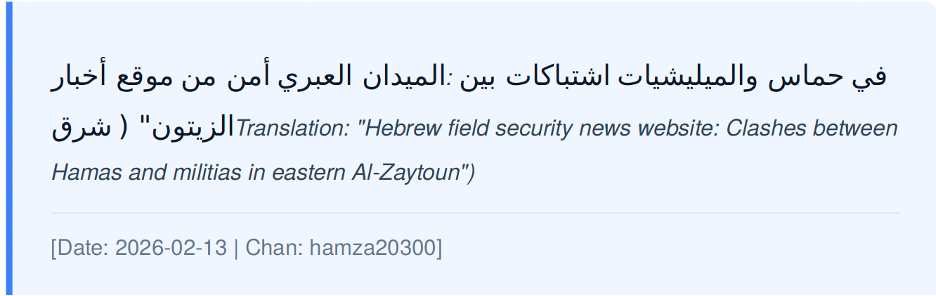
This week’s analysis featured increasing civilian discussions around clashes in Al-Zaytoun and eastern Rafah. Reports indicated confrontations between established Hamas units and reemerging local militias. This is a notable development, as there have been limited overt challenges to Hamas’s monopoly on violence since the cease-fire. If sustained, this would be a significant problem for the cease-fire’s durability, as the “truce” negotiated by Hamas’s political echelons may lose effectiveness amid ground-level clashes.
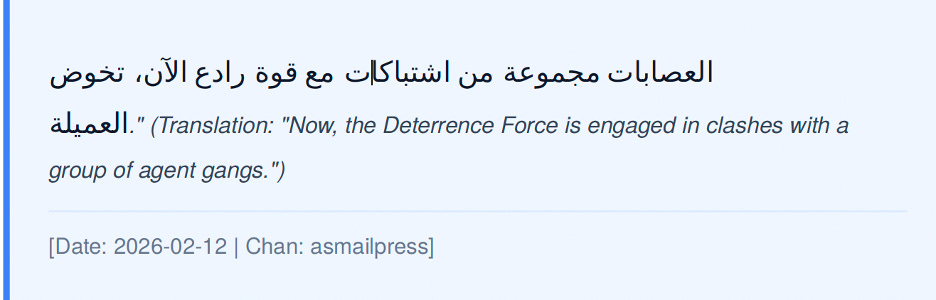
A new pattern emerged this week, where discourse featured terms like “systemic brutality” and “war crimes” in reference to internal power struggles in the Strip and between Palestinians, rather than to describe the external conflict with Israel. However, Hamas-oriented channels provided descriptions of Hamas’s “deterrence force” actively confronting “criminal gangs” and those that Hamas alleges are opposition “agents” (meaning supported by Israel). This demonstrates that Hamas is intent on asserting internal control and will continue to suppress any actor perceived as oppositional.
Price volatility
Many of the market concerns remain the same week over week: constrained liquidity, limited market access in the north, and little visible aid in northern zones, as well as insufficient aid reported in central and southern zones relative to actual demand. Prices of basic goods continue to vary widely across the Strip. For example, a tray of eggs can be reported to cost as little as 3 Israeli new shekels (NIS), or about one dollar, in some zones and 38 NIS in others, while items like chicken are only referenced in messages from central Gaza, with a range of 5 NIS to 40 NIS. Even tents have price variation, with this week’s analysis of over one thousand messages showing prices ranging anywhere from 40 NIS to 3,000 NIS in the Rafah and Khan Younis areas.

Aid distribution remains one of the most consistent sources of internal friction. Complaints center on unfair allocation, favoritism, opaque selection criteria, and exclusion from distributions. In some cases, these failings are attributed to political influence and nepotism.
International actors
International actors and Hamas collectively account for nearly 18 percent of all discussion channels reviewed. This week, many of the discussions on international actors focused on Israel, with the sentiments displayed including outrage, exhaustion, and resentment.
Sentiments toward the United States appear to remain skeptical and critical, but not entirely hostile; there is a sense of frustration more than fury. Other actors are mostly described by their incompetence, such as the United Nations, Egypt, and Qatar, but are not perceived with the same negativity as the United States or Israel. Meanwhile, discussions about the Palestinian Authority remain minimal, a symbol of its limited relevance to the lived experiences of Gazans.
Hamas messaging campaigns and narrative trends
Pro-regime Hamas channels amplified coordinated messaging efforts this week. One focal point was the status of prisoners, particularly the reported beating of a Hamas official in Israeli custody. Pro-Hamas accounts framed the incident as evidence of intentional abuse, starvation, medical neglect, and systemic targeting of prisoners. The incident was repeatedly described as a “war crime,” reinforcing broader accusations against Israeli authorities.
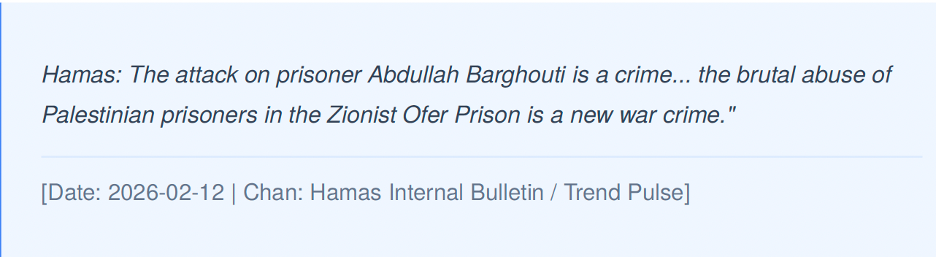
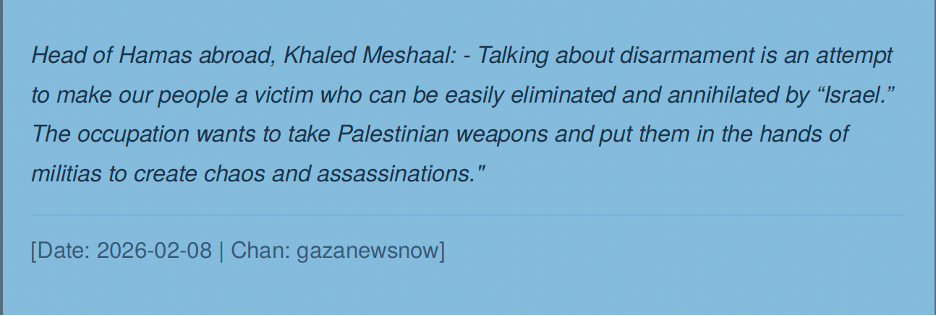
Simultaneously, Hamas leadership circulated high-level statements rejecting disarmament. This coordinated messaging discredited claims from the United States and others regarding potential disarmament agreements. Within this discourse, disarmament is equated with permanent subjugation. For example, Khaled Meshaal, the head of Hamas’s diaspora office, framed disarmament as rendering Palestinians defenseless and vulnerable to elimination. By linking prison-abuse imagery with arguments against disarmament, Hamas-supporting channels create a narrative that positions arms as the sole deterrent against unchecked Israeli violence.
What to watch
Civilian discourse this past week reflects sustained insecurity, growing frustration over aid and market instability, and increasing concern over internal fragmentation. Questions regarding who speaks for Gaza, and who meaningfully represents or serves civilian interests, remain prominent. Simultaneously, fears of deteriorating street-level security and fragmentation of hard power monopolies continue to surface.
Without stabilization of both security and governance, public trust and cohesion in Gaza will be further eroded in the coming weeks due to the convergence of external military pressure, internal factional strain, and economic volatility.