


In light of the crisis in Gaza, Realign For Palestine has partnered with Nisaba Technologies (which monitors real-time civilian discourse in Gaza via social media posts) to explore how Gaza is experienced by civilians and highlight warning signs often absent from conventional reporting.
Amid extreme and deteriorating humanitarian conditions across the Gaza Strip, civilians posted online with renewed urgency about the realities they face on the ground. This massive wave of posts eclipsed discussion devoted to political and strategic issues—but that doesn’t mean that such discussion ceased or even slowed at all.
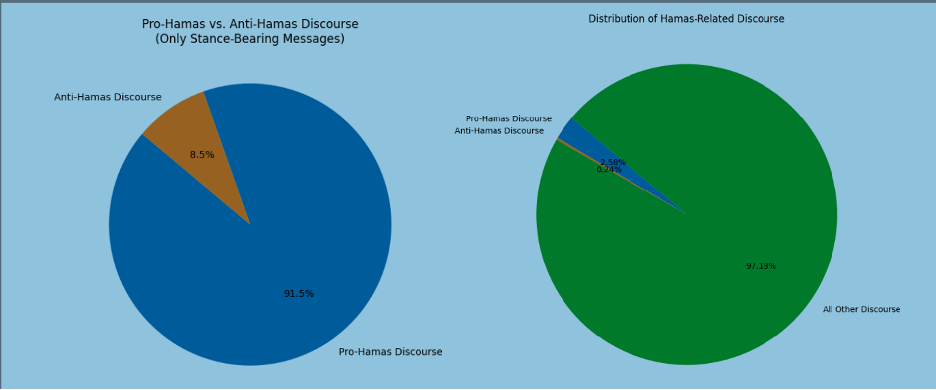
In fact, the number of messages that reference Hamas increased this week in comparison to the previous one. Civilians mentioning Hamas over this period call attention to the group’s efforts to consolidate its structure, power, and influence. Discussions point to Hamas’s new, more brutal internal security apparatus designed to cool dissent and assert the group’s continued control over aid and other resources. Yet, online discourse also featured more pro-Hamas messages and more Hamas-neutral language, despite an overwhelming amount of discussion last week assigning blame to Hamas for civilian suffering. That raises the question of whether individuals are holding off from publicly assigning blame to Hamas for civilian suffering, out of fear of retribution.
During the reporting period, civilians mentioned twenty-two distinct airstrikes and continued to discuss the de facto military barrier in the Strip, known as the Yellow Line. This border remains a vague yet deadly boundary, restricting civilians’ access and mobility across the Strip. Security-related reports remain a consistent proportion of the overall discussion, week over week, indicating that the impacts of military activity on civilians have shifted little.
As the inaugural meeting of US President Donald Trump’s Board of Peace approaches, conversations in Gaza present a bleak outlook, showcasing a deep sense of suffering, fatalism, and a dangerous resignation to the fact that Hamas’s power is here to stay.

Dangerous conditions from shooting, winter weather, and other hazards
Throughout the week, civilians from the north of the Strip recount repeat airstrikes, artillery shelling, and drone and sniper fire. During these instances, residents report, many fatalities occurred inside homes, on main streets, or other locations central to daily life. The situation in northern Gaza remains an urgent humanitarian challenge and a lethal environment. In central Gaza, civilians tell of ambulances unable to reach victims due to strikes, ongoing shelling, or a lack of fuel. Similarly, residents in southern areas of the Strip report airstrikes, artillery fire, drone fire, and even reports of naval shelling hitting residential areas and displacement camps.
On top of these dangers, the ongoing winter conditions—including temperatures as low as 50 degrees Fahrenheit, rain, and exposure to the elements—continue to compound the destruction and disaster civilians experience. Residents in central Gaza report that rainfall results in persistent mud, stagnant water, and sewage overflows, exacerbating unsanitary and hazardous conditions in these areas. In the north, civilians remain trapped by these conditions, unable to move southward, at times being displaced to different regions of the north.
Eastern lands are lost forever
Local residents allege that an increasing number of zones in eastern Gaza are now military or “no-go” zones. In the northern and eastern zones of Jabalia, Beit Lahia, Al-Tuffah, Al-Zaytoun, and Shuja’iyya, civilians report that agricultural and residential areas are inaccessible, flattened, bulldozed, and cleared. Those posting on social media describe these areas as permanently lost.
In central Gaza, residents of Al-Burejj, Nuseirat, and Deir al-Balah report that movement near the eastern areas is risky, with a high potential for being fired upon. While the concept of the Yellow Line is widely understood, its precise location remains unclear; civilians navigate these areas based on rumors and word-of-mouth. Meanwhile in southern Gaza, residents say that the large areas east of the displacement zones near Khan Younis and Rafah are “militarily sealed,” explaining they are in practice off-limits despite the absence of formal declarations. Throughout the Strip, movement near eastern zones is unpredictable and dangerous. This aligns with recent Israeli military statements. For example, a battalion commander in an Alexandroni Reserve Infantry Brigade told The Times of Israel this week, after recent incidents where Hamas operatives crossed the Yellow Line to attack Israeli troops, that “No one is allowed to cross the Yellow Line. Whoever crosses is destroyed or eliminated at that moment.”
Humanitarian access remains severely constrained. In northern Gaza, residents say that aid is scarce to nonexistent, with few reports of arrivals or aid distributions during the past week and virtually no access to fresh food, bottled water, or cooking gas. Aid is almost entirely delivered via southern Gaza (Rafah), with civilians arguing that aid does not reach northern populations. While in central Gaza, aid is visible, it remains insufficient and irregular, and points of aid delivery quickly become overcrowded, especially during water distribution. Even in southern displacement zones, residents describe aid as inadequate and unevenly distributed.
Opportunity and agency are limited
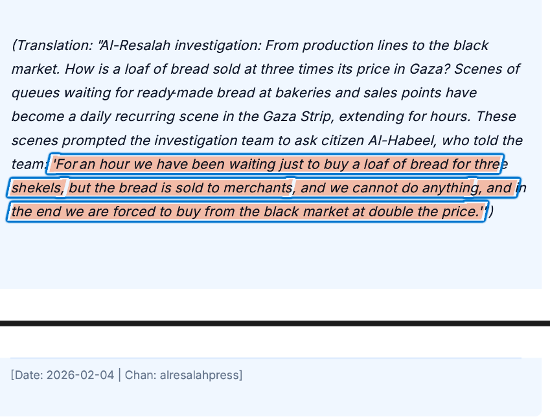
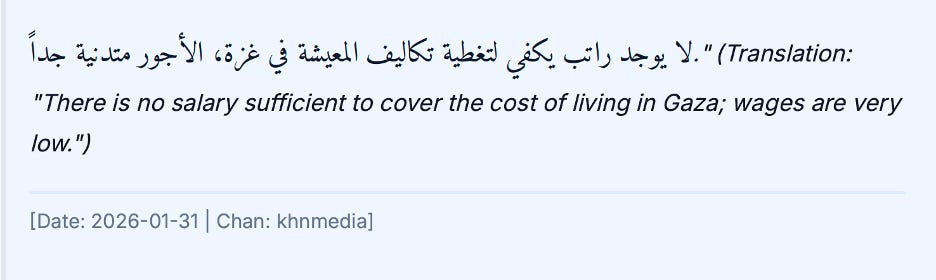
The Palestinian Monetary Authority reported that by the end of 2025, unemployment in Gaza exceeded 77 percent, with remaining employed individuals largely public-sector employees (often unpaid or receiving delayed pay) or humanitarian workers. From the conversations on social media, it appears that the lack of formal employment has led to a temporary labor market characterized by jobs unloading trucks, delivering supplies, cleaning shelters, installing tents, carrying water, and transporting goods by cart. According to discussions, opportunities are short-term, poorly paid, and physically demanding. Gazans report extreme price volatility, and the lack of cash assistance means that families in the camp areas must rely on aid or community support. Throughout the discourse, people say their poverty further erodes their social roles, self-worth, agency, and dignity.
Anti-Hamas perspectives may see their window of opportunity close
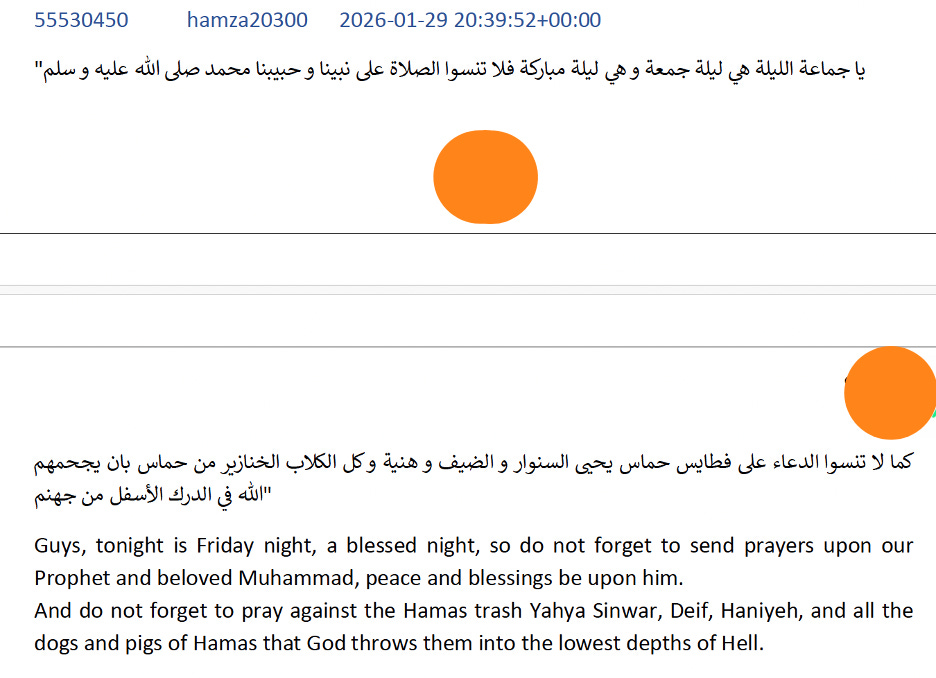
Pro-Hamas messages accounted for approximately 2.6 percent of the dataset, while explicitly anti-Hamas messages came in low at .024 percent, consistent with weeks prior. That raises fears that Gazans could be reducing, softening, and quieting their anti-Hamas statements, meaning that a window of opportunity to voice and spotlight these perspectives may be closing. Additionally, the overall low amount of discussion about Hamas indicates that the group’s role in shaping broader sentiments is limited, if not negligible.
Hamas-affiliated channels continue to deflect responsibility toward external actors. It is unlikely a coincidence that the establishment of new security and intelligence units has coincided with less visibility of dissent and a stronger pro-Hamas sentiment. Taken together, this could limit the possibilities for the emergence of organized civilian opposition to Hamas and could reinforce a climate of fear and political paralysis.
This week’s discourse from Gaza reflects the entrenchment of continued deprivation, territorial losses, and constrained expression. As diplomatic initiatives advance outside of Gaza, civilian conversations reveal a population increasingly frustrated, resigned to the permanence of struggle and to shrinking agency. The decline in overt political discourse does not automatically signal acceptance of or legitimacy for Hamas. More likely, it reflects fear of surveillance and the increasingly intense pressure for survival. Unfortunately, the likely outcome of limited political discourse and fear instilled by Hamas is that the chances for any political renewal inside Gaza risk evaporating, with consequences that extend well beyond this cease-fire moment.