


The Gaza Situation Report is a new series from Realign For Palestine, which has partnered with software provider Nisaba Technologies, which monitors real-time civilian discourse in Gaza by examining social media posts. This series builds off that effort, exploring how Gaza is experienced, discussed, and understood by civilians, highlighting patterns, perceptions, and warning signs that are often absent from conventional reporting and thus largely unseen by policymakers and narrative shapers.
Bear witness to the lived realities of Gazans and help inform a credible path forward by checking in with The Gaza Situation Report each week.
Since the cease-fire began, civilian discourse from Gaza signals a population living in paralysis amid constant danger, deprivation, and uncertainty. Across districts, residents describe a high-risk security environment, limited meaningful safety on the ground, worsening humanitarian conditions, and deepening distrust toward nearly every actor involved.
In northern Gaza, civilians describe near-total immobility. Roads are damaged, blocked, or too dangerous to use. Winter storms have destroyed already fragile shelters, while aid, water, and medical access are described as nearly nonexistent. The prevailing sentiment is abandonment. Residents speak of being cut off from the rest of the Strip, with no viable options for survival or movement.
Elsewhere in Gaza, movement remains severely constrained. Daily life is organized around avoiding risk, with civilians relying on informal alerts and word-of-mouth to navigate danger. Fatalism dominates the discourse, alongside repeated references to the seeming permanence of current conditions. As Gazans watch political processes unfold, virtually all actors, including Israel, international institutions, and Palestinian political factions, are perceived to be advancing agendas disconnected from civilian reality. Even institutions with relatively positive reputations, such as the United Nations, are described as present but largely ineffective in shaping daily life.
Loss of faith in safe zones
Civilian conversations portray an environment where death and injury are frequent and unpredictable amid conflict. Reports of artillery shelling and airstrikes across Gaza City and northern Gaza often place impacts near residential areas, with casualties framed not as the outcome of larger-scale Israeli military operations in which victims are often collateral damage but rather as the result of intentional fire in densely populated zones.
In central Gaza, discourse portrays drone activity and repeated shelling that produce fatalities across multiple incidents rather than single mass-casualty events. Civilians frequently worry about a possible slow progression from injury to death due to the lack of medical supplies, fuel, and functioning hospitals. In southern Gaza, including Khan Younis and Rafah, residents report airstrikes, naval shelling, and ground fire, reinforcing the belief that there are no genuinely safe zones or safe hours in the Strip.
Residents often relocate to survive. Civilians discuss managing the influx of families moving south from the north, alongside repeated internal relocations driven by strikes, weather, or evacuation warnings. Residents say that even designated displacement areas are unsafe and inadequate in offer ingprotection or stability.

Worries about winter weather, shelter failure, and preventable death
Severe winter weather has become a lethal force. Extreme winds and heavy rain have flooded infrastructure, worsened illness, and repeatedly destroyed tents and makeshift shelters. In southern displacement zones, residents report lacking the materials, fuel, or infrastructure needed to protect themselves from the cold; over the reporting week, temperatures dropped to as low as 42 degrees Fahrenheit at night, and at least three days of rain were recorded.
Reports of children, infants, and elderly people dying from hypothermia inside tents appear with increasing frequency. Civilians regard these deaths as preventable yet ignored, as casualties of neglect rather than combat. Gazans in southern areas say that displacement zones offer no refuge from violence or deadly living conditions.
A flood of “lost and found” posts
One of the clearest indicators of social breakdown is the volume of “lost and found” posts circulating across Gaza. These announcements—often outnumbering other types of content—include reports of children separated from parents, elderly relatives left behind, family members lost during military incidents, and essential items that have gone missing such as IDs, phones, and medical documents.
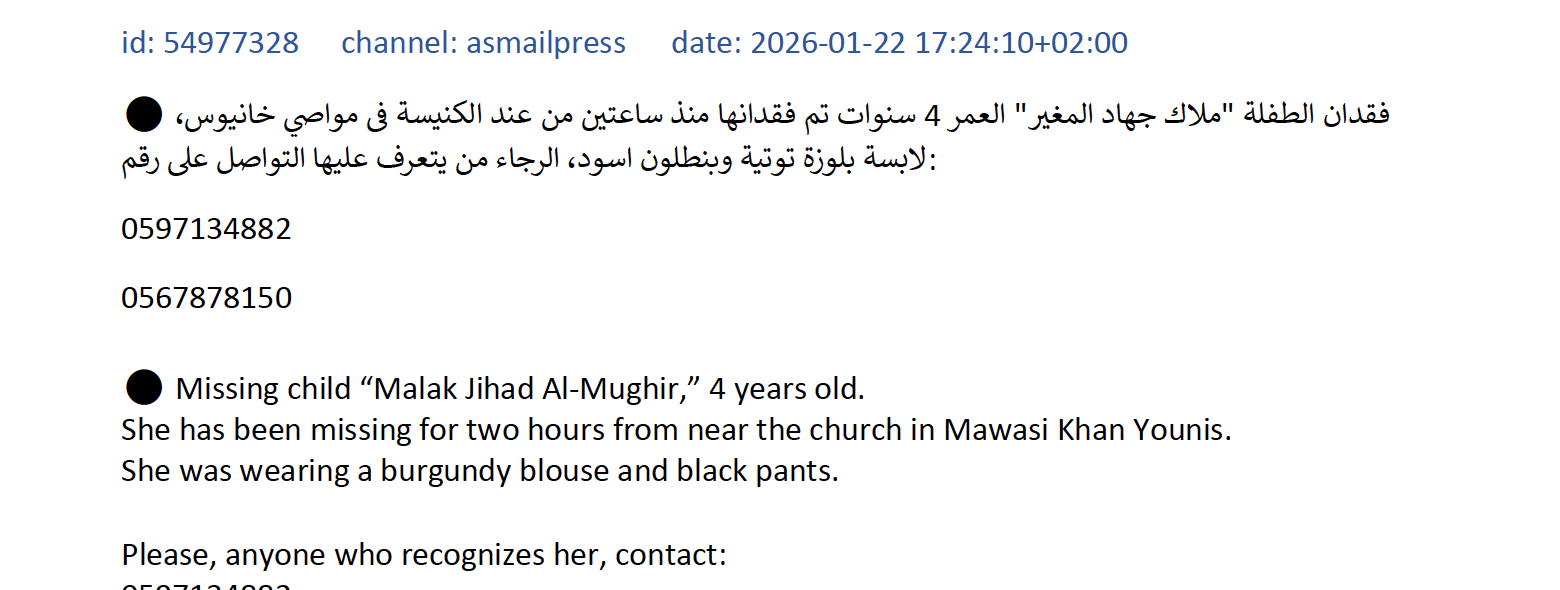
Many of these messages originate from displacement zones, highlighting the absence of centralized systems to track or reunite civilians. What might appear as mundane postings instead reflect deep administrative collapse and widespread social fragmentation.
Confusion about the Yellow Line
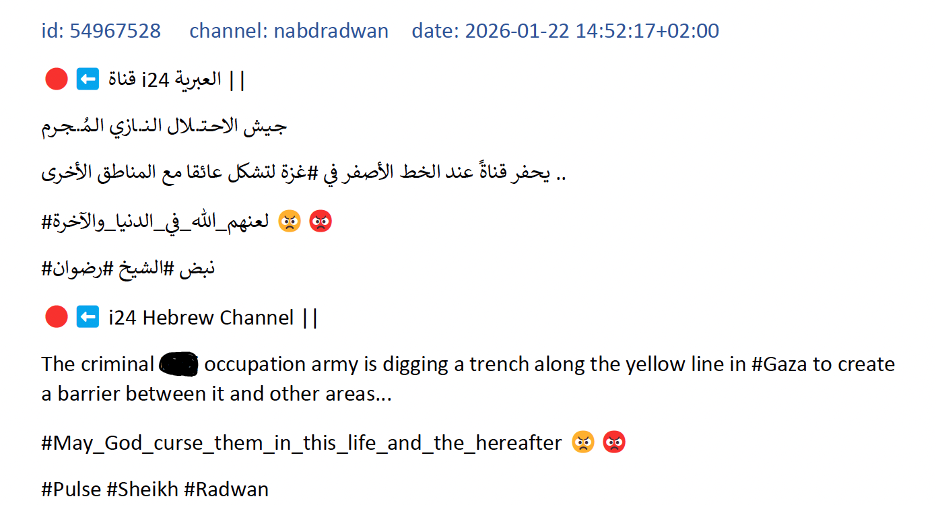
Discussion about the Yellow Line underscores a pervasive sense of fear and confusion. In Jabalia and eastern Gaza City, civilians point to bulldozing, trench digging, and home demolitions that have created protected corridors enforced by live fire and constant surveillance. Residents argue that movement across these areas is impossible.
Elsewhere in Gaza City, the Yellow Line is said to cut deeper into dense urban neighborhoods as control expands street by street, resulting in widespread housing loss and civilian exclusion. In central Gaza, many residents discuss their fear the line is moving westward without warning, creating uncertainty about future access and displacement. Civilians in southern Gaza, including Khan Younis and Rafah, describe the line as invisible but lethal, an undefined boundary where accidental crossing can trigger immediate fire.
Difficulties to secure aid and water
Aid access remains extremely limited in northern Gaza, where civilians report only small distributions of flour and canned goods. Fresh food, bottled water, cooking gas, and adequate medical aid are largely absent. Families shelter in damaged homes or improvised coverings.
In central Gaza, aid is more visible but widely described as insufficient relative to the population’s needs. Sanitation and hygiene supplies are notably scarce. While new tents are often directed toward Rafah and Khan Younis, these same areas face chronic water shortages. Across regions, civilians accuse aid systems of favoritism, diversion, or symbolic distribution.
Markets may exist, but goods are frequently unaffordable, driving the rise of cash-only survival economies. Civilians report selling aid items to buy water, fuel, or medicine, an experience described as deeply humiliating and corrosive to dignity.
Fragmentation of Hamas’s legitimacy
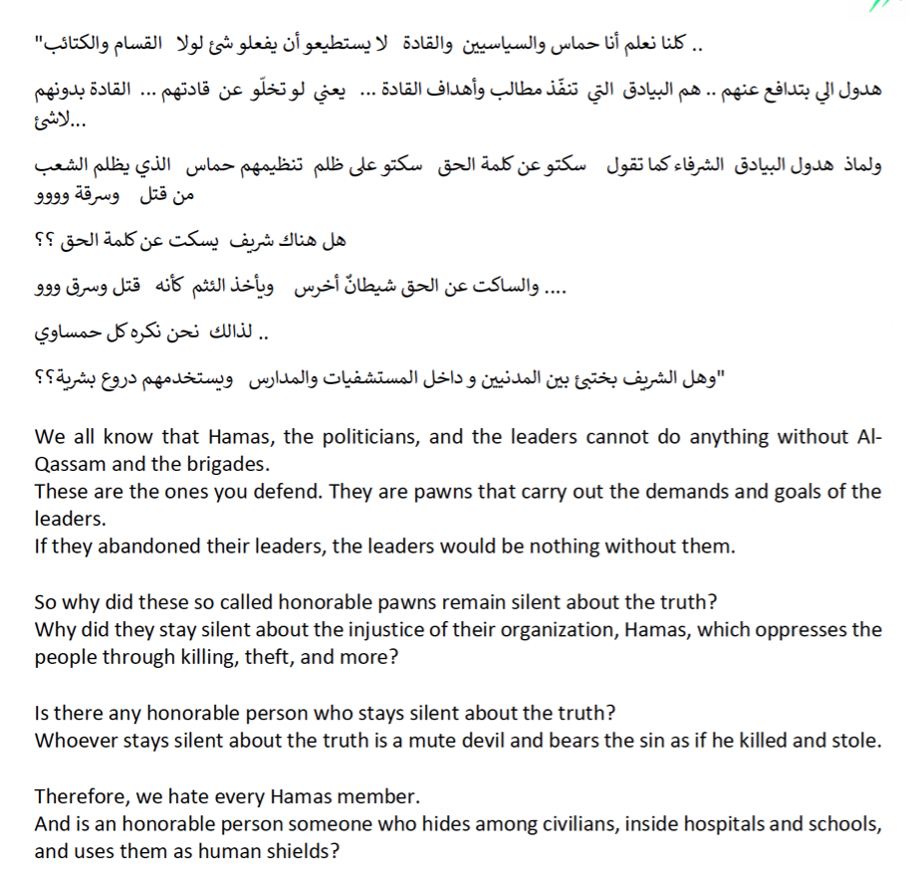
Discourse related to Hamas shows visible erosion and a fragmentation of Hamas’s legitimacy. A dominant strand frames Hamas as a failed and oppressive governing authority, accused of corruption, mismanagement, and prioritizing organizational survival over civilian welfare. Gazans directly link deteriorating living conditions to governance choices rather than framing them as unavoidable outcomes of war.
The October 7 attack remains a moral focal point in these discussions, with anger directed at those perceived to have initiated a war without the capacity to protect civilians. Alongside governance critiques are reports and allegations of coercion by Hamas-affiliated security forces, including raids, arrests, and intimidation of displaced families. These incidents generate fear, humiliation, and clan-level backlash, reframing Hamas as a threat rather than as a source of protection. Religious and ideological critiques further deepen polarization and distrust.
Mixed sentiment about external actors
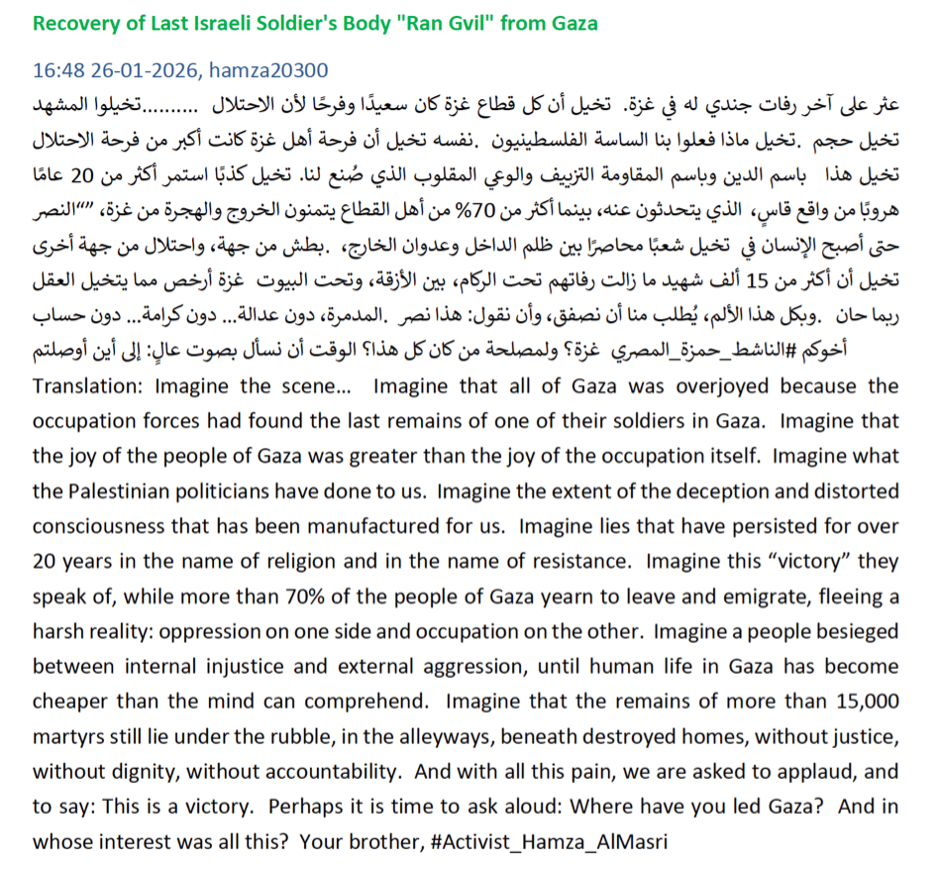
Political developments also surfaced prominently this week. The recovery of the remains of Ran Gvili, the last Israeli hostage in Gaza, prompted sharp juxtaposition in civilian discourse. Many Gazans argue that the recovery of the last hostage showed whose lives and remains are treated as recoverable and whose remain unresolved beneath rubble. The moment was widely perceived as tilting the balance of leverage in Israel’s favor within ongoing political processes.
Many civilians view Egypt ambivalently as Gaza’s only point of exit (through Rafah) but simultaneously regard it as a suffocating gatekeeper. Gazans also say the United Nations is present but ineffective, and label the United States as the ultimate decision-maker and enabler.
This discourse matters
This week’s civilian discourse makes clear that Gaza’s crisis is no longer defined solely by active hostilities. Normalized deprivation, fear, and abandonment increasingly shape this crisis. When movement is dangerous, aid is unreliable, shelter is lethal, and authority is contested, survival itself is experienced almost as a punishment.
These perceptions matter. They shape trust, compliance, legitimacy, and the prospects for any cease-fire, governance transition, or recovery framework. By ignoring this civilian discourse, one risks overlooking the conditions that determine whether any political or humanitarian intervention can hold.